An unheralded Buzzards Bay success story:
The Broad Marsh River Stormwater Remediation Project
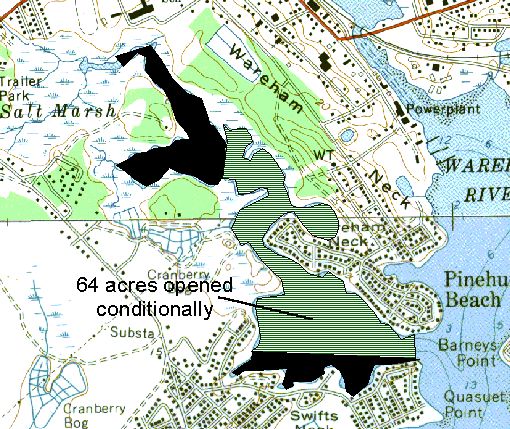
About one year ago, something important happened to a shellfish bed in the Town of Wareham.
In public meeting with the Wareham Board of Selectmen, the Massachusetts Division of Marine
Fisheries informed the town that a 64-acre area of Broad Marsh River was being reclassified.
The meeting, set up to describe the opening date and operating conditions of the site,
was broadcast on local cable access TV. Except to some shellfishermen, municipal officials,
and residents in the Town of Wareham, the significance of the meeting was perhaps not
fully appreciated. The shellfish area, designated as part Shellfish Resource Area BB36,
was being changed from "prohibited" to shellfishing to a "conditionally approved."
In plain English, this meant that in an area where it had been formerly illegal to collect
shellfish for many years, commercial and recreational shellfishermen could now collect
soft-shelled clams and quahogs to eat or sell. The collecting of shellfish was still
prohibited during, and for five days after, a moderate rain. However, where shellfish
could never be collected, they could now be harvested a good portion of each year.
The reclassification of Broad Marsh River occurred because water quality had improved in this
estuary. What is so remarkable about this event, is not that it occurred (although admittedly new
shellfish bed closures are unfortunately the more likely trend in many areas), but why it occurred.
The remarkable aspect of the opening was that it was the direct result of the implementation of a
stormwater remediation project. Specifically the Town of Wareham Public Works Department
constructed and put in place a system to treat stormwater. They were able to do this because of
funding from Massachusetts Department of Environmental Protection's Section 319 Non-Point
Source Pollution Program, and technical assistance and guidance by the Buzzards Bay Project,
USDA Natural Resource Conservation Service, and the Massachusetts Department of Marine
Fisheries
The whole story
Broad Marsh River, like
many small estuaries in
southeastern Massachusetts
had shellfish bed closures
because of elevated fecal
coliform levels. And like
many other bays and
harbors these closures were
not the result of a some
large outfall pipe, but the
result of cumulative
impacts from many
sources, most of which
were conveyed by road
stormwater pipes directly to
the bay.
The Broad Marsh River Stormwater Remediation Project began in 1991 when the town of
Wareham requested funding through the Buzzards Bay Project's (BBP) mini-grants program.
The Town submitted a proposal to improve the water quality in the lower section of Broad Marsh
River through the remediation of stormwater discharges. These discharges showed elevated
counts of fecal coliform bacteria during rain storms. The Town, in consultation with the
Massachusetts Division of Marine Fisheries (DMF), believed these discharges were a significant
contributor to shellfish bed closures in Broad Marsh River. In addition, several public and
private beaches are located along the river. While these beaches had not been closed due to fecal
coliform bacteria, the Town was concerned about the public health risks associated with the
stormwater runoff.
Due to limited finances, the Buzzards Bay Project was unable to provide the funds for the Broad
Marsh River Project in 1991. However, in 1992, the Buzzards Bay Project, in collaboration with
the Town of Wareham, submitted a proposal to the Department of Environmental Protection,
Office of Watershed Management (the Department), through the S.319 Nonpoint Source
Pollution (NPS) program. In June 1993, the Town was awarded $88,450.00 from the
Department to remediate the stormwater discharges. In the proposal, the town committed to an
additional $71,020.00 contribution as match (cash and in-kind).
In 1993, the BBP and the Town requested planning and technical assistance from the USDA
Natural Resources Conservation Service (NRCS). NRCS put together an interdisciplinary team
(including engineers, biologists, soil conservationists, a geologist and a soil scientist) to work
with BBP and Town representatives to identify alternatives and select best management
practices. Several alternatives to reduce the coliform loads from the stormwater runoff were
considered. The sandy soils in the project area made infiltration a practicable alternative.
Infiltration practices such as trenches and basins were known to be highly effective in removing
fecal coliform bacteria from stormwater runoff. Due to land constraints, subsurface
(under-the-road) infiltration structures, were selected as the most economically feasible for the
Town to install.
As part of the Memorandum of Understanding with the Town, NRCS provided the site
investigations, survey work and designs needed to implement the project. The design of the
infiltration structures went through several revisions before being finalized in April 1995. The
extended length of time needed for completing the designs were the result of considerably less
than expected space for infiltration basins due to the narrowness of the roads and the
configuration of the many utilities under the road. This forced a reevaluation of infiltration
targets and policies by the Buzzards Bay Project, NRCS, and the Town.
In October 1995, the Town awarded the construction contract to a local firm (C. C. Construction)
which began in November in the Pinehurst Beach section. Installed were two types of infiltration
structures, concrete galleys and plastic chambers. The plastic chambers were utilized in areas
with high groundwater. Construction of this project was completed in April 1996. To complete
the construction of the project, the Town cash contribution alone equaled more than $70,000.
With in-kind contributions by the Town, the Town's total match was estimated to be
approximately $85,000.
Prior to the construction of the infiltration structures, the Town distributed a Broad Marsh River
Project brochure to homeowners in the immediate area. The brochure, written by the Buzzards
Bay Project, described the purpose of the project, what the construction entailed, and what the
general public could do to improve water quality. The materials in the brochure were also used to
develop an informational sign and a display. The sign was placed onsite during construction.
Once the construction was completed, the display, depicting the locations of completed Wareham
stormwater remediation projects, was put together by the Town and the Buzzards Bay Project.
The display is currently in the Wareham Public Library and will eventually be placed in the
Wareham Town Hall.
Following construction, the Buzzards Bay Project monitored three infiltration systems starting in
October 1996 and ending in June 1997. Parameters such as metals (Zinc, Copper, Cadmium,
Chromium, and Lead), Total Suspended Solids (TSS), Total Petroleum Hydrocarbons (TPH), and
Volatile Organics (VOC) were monitored in the catch basins and the groundwater wells once
during a rain event. Most of these contaminants that had elevated levels in the discharge were
reduced greatly by the infiltration.
Fecal coliform bacteria, the pollutant of primary concern, was monitored during five rain events
(during the rain or shortly after). Samples were taken at the catch basins (when water was
flowing in the basin), the groundwater wells, and the river. The Division of Marine Fisheries, in
their efforts to assist the Town of Wareham and the Buzzards Bay Project, increased their fecal coliform monitoring of the
river and also provided verbal observations of the discharges. Overall, the monitoring results
from the catch basins and groundwater monitoring wells, indicate that infiltration structures are
highly effective in removing fecal coliform bacteria, often exceeding 99.99% reductions.
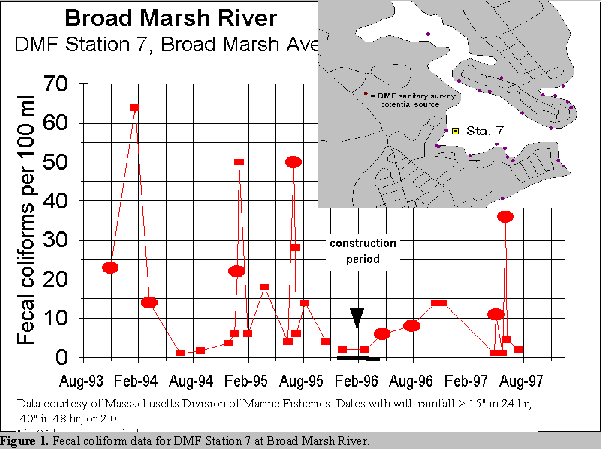
However, fecal coliform levels in the receiving waters were more difficult to interpret because
many other non-point sources of pollution contribute to both background and stormwater related
increases. An example of the variability in water quality at one of the stations monitored is
shown in Figure 1. Much of the variability shown is due to differences in rainfall volumes, water
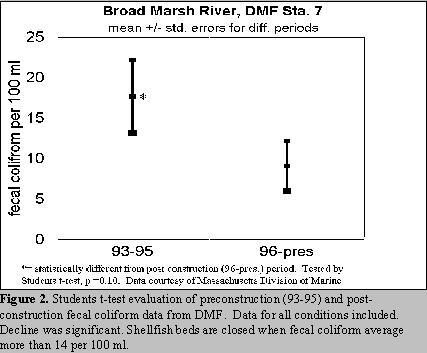
temperature, and time since the last rainfall. Despite this noise, a statistical analysis of the data by
the BBP as shown in Figure 2, demonstrated that post-construction fecal concentrations in the
receiving waters were significantly lower than preconstruction conditions.
Based on these data, at the end of 1998 the Massachusetts Division of Marine Fisheries, the agency
responsible for opening shellfish beds in Massachusetts, opened 67 acres of the Broad Marsh River
estuary to shellfishing for the first time in many years. The new classification for the area means
that the shellfish beds remain open except when there is a rainfall of at least 0.5 inches when this
bay is closed for five days. This remediation project has now become one of the best examples in
Buzzards Bay of how the remediation of the first flush of stormwater discharges can result in the
reopening of shellfish beds. It is also a tribute to the hard work of Buzzards Bay municipalities
and the Division of Marine Fisheries, working cooperatively, to achieve environmental goals.
----- You are visitor  since our start.

 Broad Marsh River Stormwater Remediation Project.
This is the final report (as a 700K PDF file) on the Town of Wareham and DEP 319 program funded stormwater remediation project to help open shellfish beds.